
PDR Guides · 7 min read
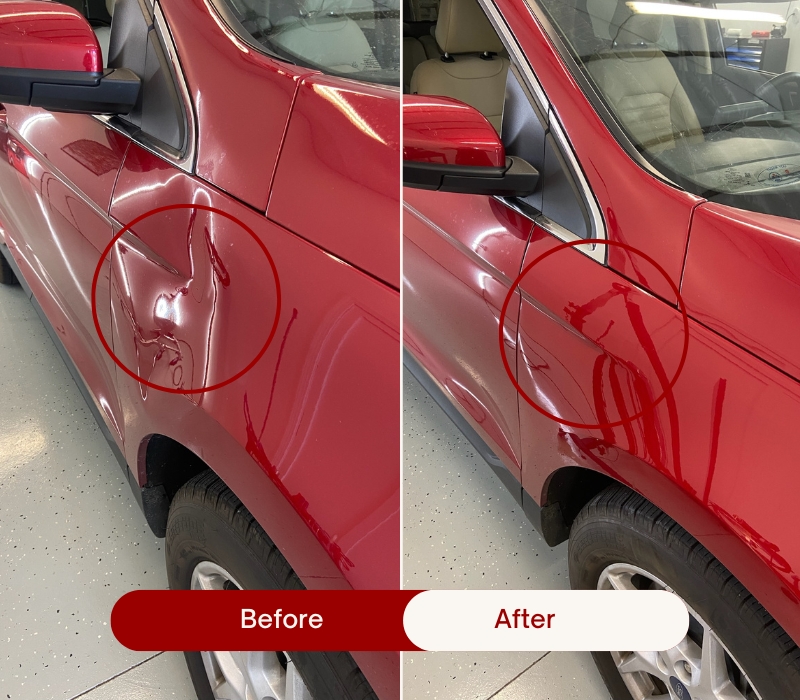
People assume paintless dent repair is only for little parking lot dings. In practice, some of the most satisfying PDR work is on large dents, the kind that make an owner assume the panel is finished. A wide, smooth dent in a door or quarter panel can often be brought back to a clean reflection with the factory paint untouched.
What actually rules PDR out is rarely size.
Why size is the wrong measure
A dent 12 inches across that is shallow and smooth has displaced metal gently over a wide area. There is a lot of surface to work with, and the metal has not been stretched hard at any single point. That is a good candidate.
A dent two inches across from a sharp corner impact has concentrated all the force into one small area. The metal there may be stretched thin, and stretched metal cannot simply be pushed back. That small dent may be the harder repair.
The four things that decide a large dent
1. Paint condition
Unbroken paint keeps PDR on the table. Cracks or chips mean refinishing will be needed regardless.
2. Depth relative to width
Shallow and wide is friendly. Deep and narrow is not.
3. Metal stretch
If the metal has been stretched, the panel has more surface area than it started with and the excess has to be worked back in. That is advanced work and it has limits.
4. Access
Large dents often sit over braces, in doors packed with hardware, or in quarter panels that require interior removal. Access can be the difference between a straightforward job and a long one.
Common large-dent scenarios we see in Denver
- Shopping cart runs down a door in a supermarket lot
- Backing into a post or a low wall in a parking garage
- Another vehicle's door swung hard into a rear door or fender
- Snow and ice sliding off a roof or garage onto a hood or trunk
- Debris strikes on I-25 and I-70 during storms
Most of these leave paint intact, which is why so many of them are repairable without a repaint.
What a realistic outcome looks like
On a good candidate, the panel is returned to a clean reflection and the repair is not visible in normal light. On a difficult one, the honest outcome may be a very substantial improvement with a faint trace visible at a low angle in direct sun. We describe which of those you are looking at before any work starts, because the worst outcome is a customer expecting one and receiving the other.
If a body shop is genuinely the better answer, we say so. See PDR versus body shop for the comparison.
Getting a large dent assessed
Large damage benefits from more photographs than a small ding. Send one low-angle shot with a reflection running through the damage, one straight on, one from each end of the panel, and one wide shot of the vehicle. Add a note about how it happened, because impact direction tells us where the metal moved.
Our large dent repair page covers the service, and the estimate form is the fastest way to get an answer.